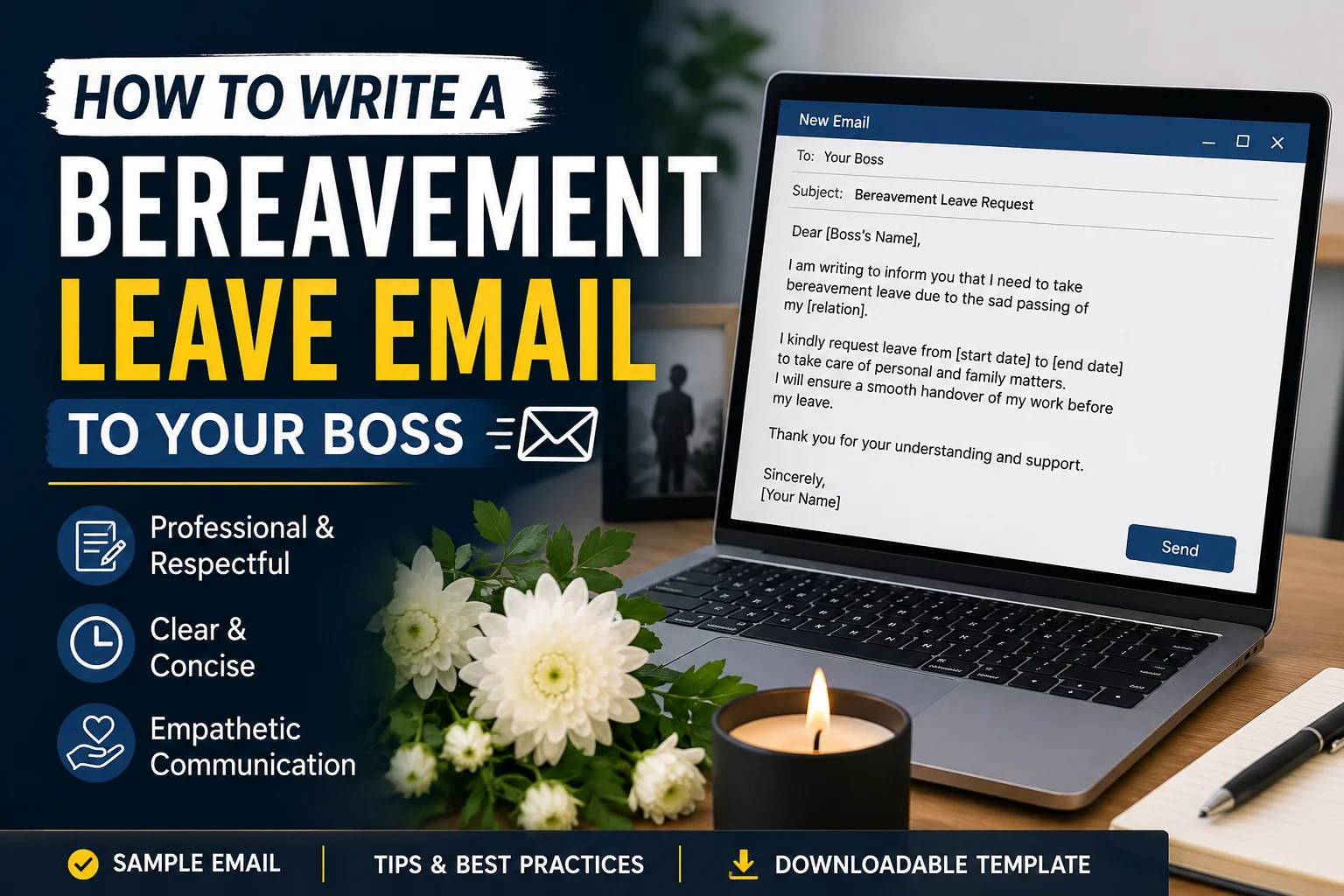
Losing a loved one is one of the hardest experiences in life. During this painful time, the last thing you want to worry about is figuring out exactly what to say to your boss or HR department.
However, you still need to notify your workplace so they know you are safe and can cover your work while you grieve.
Quick Answer: How to Write a Bereavement Email
To write a professional bereavement leave email, keep it concise and direct. Include these 4 elements: 1. Your relationship to the deceased (e.g., "my father"), 2. The exact dates you will be away, 3. A brief work handover plan (optional), and 4. Your availability (e.g., "I will be offline"). You do not need to share personal details regarding the passing. Use the free templates below to copy, paste, and send immediately.
We wrote this guide to make this process as easy and stress-free as possible. In this article, you will learn exactly what to say, who to email, and how to format it. Most importantly, we have provided ready-to-use, simple templates. You can just copy, paste, fill in the blanks, and send it off immediately.
In a rush? Scroll down directly to the templates section. You can copy the text by clicking the button in the top right corner of each box.
What is Bereavement Leave?
Bereavement leave (sometimes called compassionate leave) is time off granted to an employee when a family member or close friend passes away. It gives you the necessary time to grieve, handle funeral arrangements, and take care of family matters without the immediate stress of work obligations.
Most companies offer between 3 to 5 days of paid bereavement leave for immediate family members (parents, siblings, spouses, children). However, policies vary greatly from company to company. Right now, do not worry too much about the exact policy. Your immediate priority is simply to notify your team that you need to step away.
4 Things to Include in Your Email
When you write a bereavement leave email, keep it very short. You do not need to share deep personal details about how the person passed away. Keep it professional, respectful, and direct.
Here are the only 4 things your boss or HR department needs to know:
- Who passed away: State their relationship to you (e.g., "my grandfather", "my mother"). You don't need to give their actual name.
- The dates you will be away: Give the exact date you are leaving and the date you plan to return. If you aren't sure when you will return, that is completely okay—just state that you are unsure.
- Work handover (optional): If you have an urgent project, briefly mention who is covering for you (e.g., "Sarah will handle my daily meetings").
- Contact information: State whether you will be completely offline, or if you can be reached for absolute emergencies. (We highly recommend staying completely offline to properly grieve).
What Subject Line Should I Use?
The subject line needs to be highly visible so your manager opens the email immediately amidst a busy inbox. Here are a few simple examples you can use:
- Bereavement Leave – [Your Name]
- Urgent: Bereavement Leave Request – [Your Name]
- Absence Due to Family Death – [Your Name]
- Leave of Absence Request – [Your Name]
Ready-to-Use English Templates
Here are 4 templates for different situations. Copy the one that fits your exact situation best.
Template 1: Short & Direct (To Your Manager)
Use this if you have a good relationship with your boss and just need to send a quick, simple notification.
Dear [Manager's Name],
I am writing this to let you know that my [relation, e.g., grandmother] passed away recently. Therefore, I need to request bereavement leave starting today, [Date].
I plan to return to work on [Return Date]. During my absence, [Colleague's Name] has kindly agreed to cover my urgent tasks. I will not be checking my email while I am away so I can focus on my family.
Thank you for understanding during this difficult time.
Sincerely,
[Your Name]
Template 2: Formal (To HR Department)
Use this if your company requires you to email the Human Resources department formally to process your leave days.
Dear HR Team,
I am writing to formally request bereavement leave due to the loss of my [relation, e.g., father]. I will be taking time off from [Start Date] to [End Date] to attend the funeral and be with my family.
I have already informed my manager, [Manager's Name], about my absence. Could you please let me know what the company policy is regarding paid bereavement leave and if you need any documentation from me upon my return?
Thank you for your support.
Best regards,
[Your Name]
[Your Employee ID, if applicable]
Template 3: Not Sure When You Will Return
Sometimes, cross-country travel is required, or the emotional toll is too heavy to predict a return date. Use this template if your return date is unconfirmed.
Dear [Manager's Name],
Please accept this email as notification that my [relation, e.g., sister] has passed away. I will need to take bereavement leave starting immediately.
At this moment, I am dealing with travel and funeral arrangements, so I am not entirely sure which day I will be back in the office. I expect to be away for at least [Number] days, and I will update you by [Date] regarding my exact return.
I will be completely offline during this time. Please contact [Colleague's Name] for any project updates.
Thank you for your patience and understanding.
Sincerely,
[Your Name]
Need a formatted PDF letter?
If your HR department requires a formal, printable letter, use our free tool. It formats everything instantly with zero login required.
Generate Leave Application PDFMultilingual Bereavement Leave Templates
We understand that many professionals communicate with management in their native languages. While you can use the dropdown at the top of this page to translate the whole guide, here are ready-to-copy short templates in popular languages.
Template in Hindi (हिंदी)
प्रिय [मैनेजर का नाम],
मुझे आपको यह बताते हुए बहुत दुख हो रहा है कि हाल ही में मेरे [रिश्ता, जैसे: दादाजी] का निधन हो गया है। इस कठिन समय में मुझे अपने परिवार के साथ रहने के लिए शोक अवकाश (bereavement leave) की आवश्यकता है।
मैं [प्रारंभ तिथि] से [अंतिम तिथि] तक कार्यालय में उपस्थित नहीं हो पाऊँगा/पाऊँगी। मेरी अनुपस्थिति में मेरे काम की जिम्मेदारी [सहकर्मी का नाम] संभालेंगे।
इस मुश्किल समय में समझने के लिए आपका धन्यवाद।
सादर,
[आपका नाम]
Template in Urdu (اردو)
محترم [مینیجر کا نام]،
مجھے آپ کو یہ بتاتے ہوئے بہت دکھ ہو رہا ہے کہ حال ہی میں میرے [رشتہ، جیسے: والد صاحب] کا انتقال ہو گیا ہے۔ اس مشکل وقت میں مجھے اپنے خاندان کے ساتھ رہنے کے لیے چھٹی کی ضرورت ہے۔
میں [شروع کی تاریخ] سے [واپسی کی تاریخ] تک دفتر حاضر نہیں ہو سکوں گا۔ میری غیر موجودگی میں [ساتھی کا نام] میرے کام کی دیکھ بھال کریں گے۔
اس مشکل وقت میں تعاون کے لیے آپ کا شکریہ۔
والسلام،
[آپ کا نام]
Template in Arabic (العربية)
عزيزي [اسم المدير]،
يؤسفني جداً أن أبلغكم بوفاة [صلة القرابة، مثل: جدي] مؤخراً. لذا، أرجو الموافقة على منحي إجازة فجيعة ابتداءً من اليوم [التاريخ].
أتوقع العودة إلى العمل يوم [تاريخ العودة]. خلال فترة غيابي، سيقوم [اسم الزميل] بمتابعة المهام العاجلة بدلاً عني. سأكون غير متاح للرد على رسائل البريد الإلكتروني خلال هذه الفترة.
شكراً لتفهمكم ودعمكم في هذا الوقت الصعب.
مع خالص التحيات،
[اسمك]
Template in Nepali (नेपाली)
आदरणीय [प्रबन्धकको नाम],
म तपाईंलाई यो जानकारी गराउन धेरै दुःखी छु कि भर्खरै मेरो [नाता, जस्तै: हजुरबुबा] को निधन भएको छ। यस दुःखद घडीमा परिवारको साथमा रहन मलाई शोक बिदाको आवश्यकता छ।
म [सुरुको मिति] देखि [फर्कने मिति] सम्म कार्यालयमा उपस्थित हुन सक्दिनँ। मेरो अनुपस्थितिमा मेरो काम [सहकर्मीको नाम] ले हेर्नुहुनेछ।
यस कठिन समयमा बुझिदिनुभएकोमा धन्यवाद।
भवदीय,
[तपाईंको नाम]
HR Policies: FMLA, Paid vs Unpaid Time Off
A common source of anxiety is whether bereavement leave is paid and if it falls under federal laws like FMLA (in the United States). Here is the straightforward answer:
- FMLA Does Not Apply: In the US, the Family and Medical Leave Act (FMLA) is strictly for caring for living family members with serious health conditions or your own medical leave. Bereavement is not a qualifying reason for FMLA.
- Paid Leave: There is no federal law mandating paid bereavement leave in the US. However, over 80% of major corporations offer 3 to 5 paid days for immediate family members as a company perk.
- Unpaid Leave & PTO: If your company does not offer paid bereavement, you have the legal right to request the use of your standard Paid Time Off (PTO), sick days, or unpaid leave.
Frequently Asked Questions (FAQ)
Conclusion
Sending a bereavement email should be a 30-second task. Choose a template above, fill in the brackets, and send it to your manager and HR team. Once you hit send, close your laptop or turn off your work phone notifications.
Your job right now is not to worry about spreadsheets or meetings. Your job is to be with your family, process your grief, and take care of your own mental health during this challenging time.