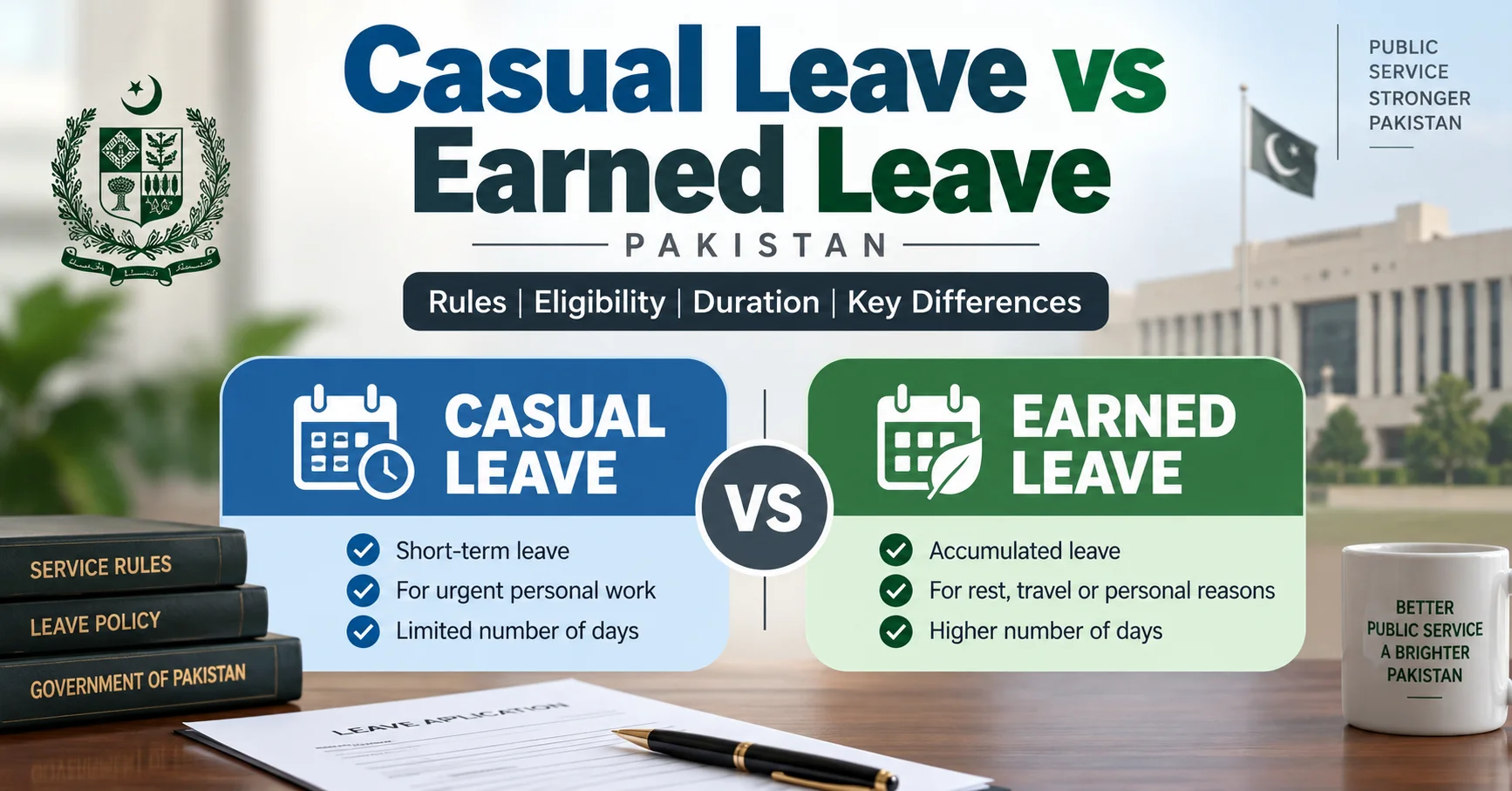
In Pakistan, Casual Leave (CL) and Earned Leave (EL) are not interchangeable. The correct entitlement depends on whether you are covered by a private-sector labour law, a provincial shops and establishments law, or government service rules.
This guide explains the casual leave vs earned leave difference in Pakistan, the commonly referenced West Pakistan Shops and Establishments Ordinance, 1969, federal government leave rules, and professional leave application formats you can copy and edit.
Quick Answer: CL vs EL in Pakistan
Casual Leave (CL) is generally used for short personal or urgent needs and, under section 15 of the West Pakistan Shops and Establishments Ordinance, is 10 days with full wages in a calendar year and ordinarily not more than three days at a time. Annual/Earned Leave is a separate entitlement; under section 14 of that Ordinance, an eligible employee gets 14 days with full wages after 12 months of continuous employment. Federal civil servants follow the Revised Leave Rules, 1980, under which leave on full pay is earned at 4 days for each calendar month of duty rendered.
Casual Leave vs Earned Leave Pakistan: Key Difference
The easiest way to understand CL and EL difference in Pakistan is to compare their purpose, accumulation and entitlement. The exact rule can differ by province, employment category and the service or company rules that apply to you.
| Point | Casual Leave (CL) | Earned / Annual Leave (EL) |
|---|---|---|
| Main purpose | Short personal, urgent or unforeseen needs | Planned longer absence or annual rest |
| West Pakistan Ordinance example | 10 paid days in a calendar year | 14 paid days after 12 months of continuous employment |
| Accumulation | Not accumulated under section 15 | Unused annual leave can carry forward subject to the statutory limit |
| Typical planning | Short notice where circumstances require | Usually planned in advance |
| Important | These figures should not be treated as a universal rule for every employee in Pakistan; government servants and employees covered by different provincial or employment laws can have different entitlements. | |
Important: “Earned Leave” is a common workplace term, but the legal label and accrual mechanism are not identical everywhere in Pakistan. Check your applicable provincial law, appointment/service rules and employer policy.
Private-Sector Rules & West Pakistan Shops and Establishments Ordinance
The West Pakistan Shops and Establishments Ordinance, 1969 separates annual leave from casual leave. Section 14 deals with annual leave, while section 15 deals with casual and sick leave. The Ordinance states that an eligible employee is entitled to 14 days of annual leave with full wages after 12 months of continuous employment and 10 days of casual leave with full wages in a calendar year. Casual leave ordinarily should not be granted for more than three days at a time and is not accumulated.
The Ordinance also contains exemptions. In particular, section 18 says sections 14–17 do not apply to certain employees in commercial establishments covered by the Industrial and Commercial Employment (Standing Orders) framework. This is why a blanket “Pakistan has exactly one leave rule” statement can be misleading.
How many casual leaves per year in Pakistan?
For employees covered by section 15 of the West Pakistan Shops and Establishments Ordinance, the stated entitlement is 10 days of casual leave with full wages in a calendar year. The provision also says casual leave shall not ordinarily be granted for more than three days at a time and shall not be accumulated.
Earned leave after 12 months Pakistan
For employees covered by section 14, annual leave is 14 days with full wages after 12 months of continuous employment. Unused leave can be added to the following period, subject to the accumulation ceiling stated in the Ordinance.
Government Employees: Earned Leave Under the Revised Leave Rules, 1980
Federal civil servants follow a separate framework. The Government of Pakistan's Revised Leave Rules, 1980 provide that leave on full pay is earned at the rate of four days for every calendar month of the period of duty rendered. The rules also state that there is no maximum limit on accumulation of leave on full pay.
Therefore, it would be inaccurate to tell every government employee that “earned leave is 14 days after 12 months.” That 14-day figure comes from the Shops and Establishments Ordinance framework; federal civil-servant leave is calculated under the 1980 rules.
When Should You Use CL or EL?
Casual Leave: Use CL for a short absence caused by a personal matter, urgent family work, an appointment, a brief errand or another reason that fits your office policy.
Earned / Annual Leave: Use EL when you have planned a longer break, trip, personal work or other extended absence. Since it may be based on an accumulated leave balance, check your available balance before applying.
For both categories, state the exact dates, number of days and a brief plan for urgent work or handover. This gives your manager or HR the information needed to process the application quickly.
Bilingual Casual Leave Application Format (English & Urdu)
This copy-ready format can be used for an office or HR department. Replace the bracketed fields with your information.
To,
The Manager / HR Manager,
[Company / Department Name],
[City]
Date: [Date]
Respected Sir/Madam,
I respectfully request [Number] day(s) of casual leave from [Start Date] to [End Date] due to [brief personal reason].
I will complete any urgent pending work before my leave and will make the necessary handover for matters that require attention during my absence. Kindly approve my casual leave for the above-mentioned period.
Thank you for your consideration.
Yours faithfully,
[Your Name]
[Designation / Department]
Employee ID: [ID]
Bilingual Earned Leave Application Format (English & Urdu)
Use this format when requesting planned leave to be adjusted against your earned or annual leave balance, subject to your applicable rules and employer approval.
To,
The Manager / HR Manager,
[Company / Department Name]
Date: [Date]
Respected Sir/Madam,
I am writing to request [Number] days of earned/annual leave from [Start Date] to [End Date] for [reason / planned personal work].
I have reviewed my current assignments and will complete priority tasks before my departure. I will also arrange the necessary handover to [Colleague's Name] for urgent matters during my absence.
Kindly adjust the approved period against my available earned/annual leave balance and grant me leave for the dates requested.
Yours sincerely,
[Your Name]
[Designation / Department]
Employee ID: [ID]
Frequently Asked Questions (FAQ)
Need a Ready-to-Use Leave Application?
Use LeaveDraft's free generator to create a professional casual leave, earned leave or other office leave application and download it as a PDF.
Go to Free GeneratorLegal note: This page is for general information, not legal advice. Leave entitlements in Pakistan can differ by province, sector, establishment and service rules. For an official entitlement, payroll question or dispute, verify the rules applicable to your employment.